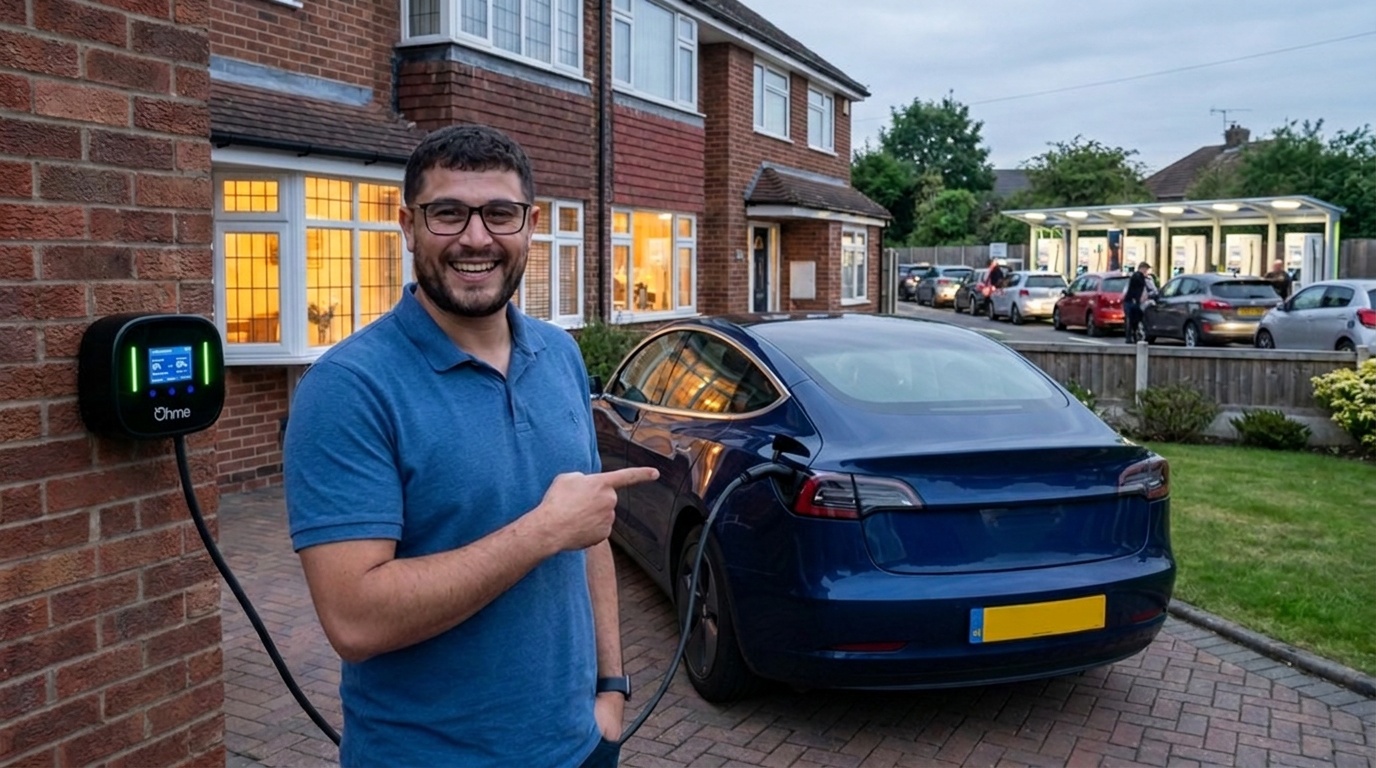

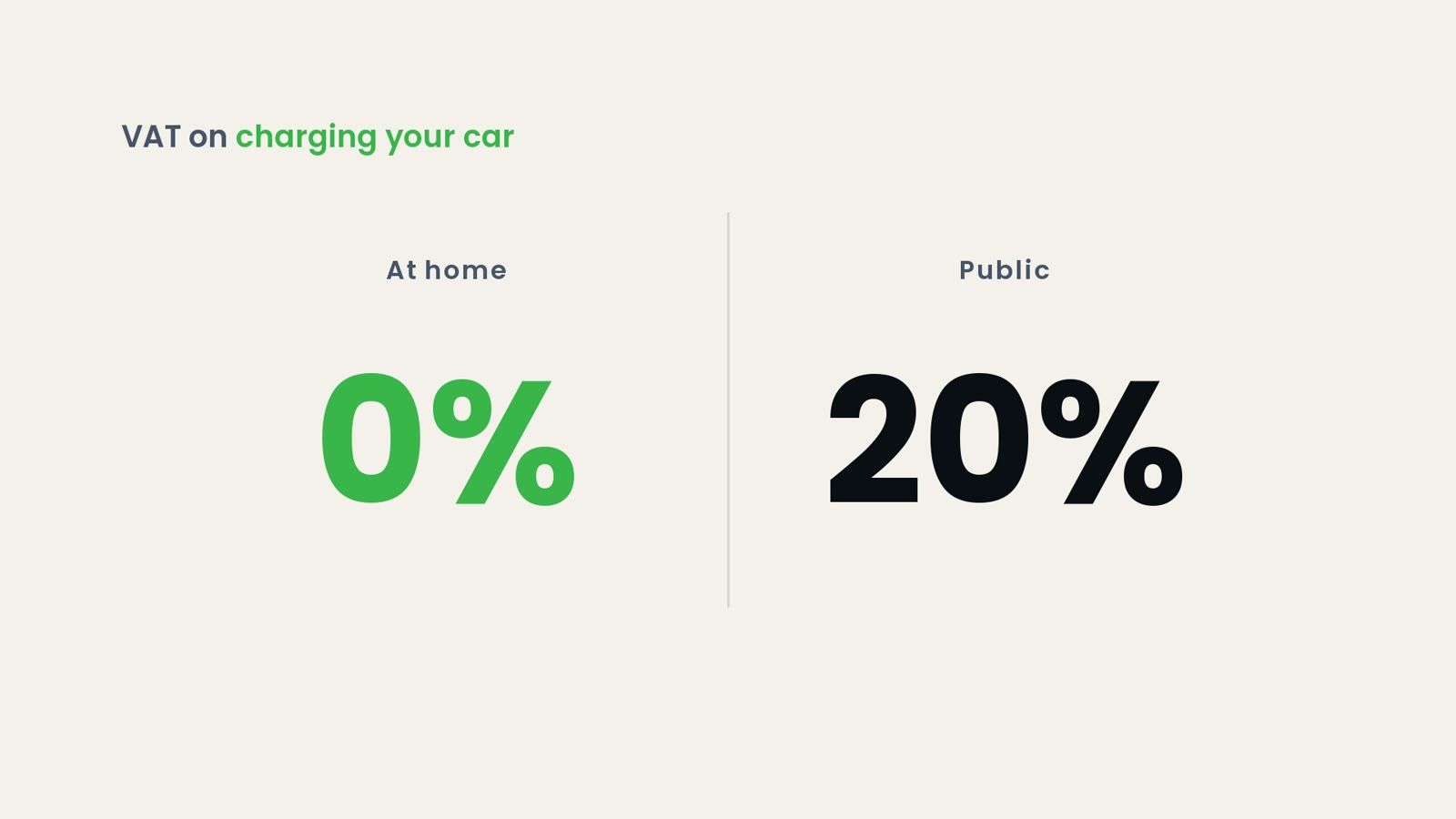
Since 1 October 2026 there's been no VAT on the electricity you use at home. 0%. Plug into a public charger and you're still paying 20% VAT on top. The gap between charging on your drive and charging down the road has never been bigger. Here's what that gap is actually worth, how to get the cheapest rate at home, and how to pay less on the days you do need a public charger.
What's changed
- VAT on household electricity dropped from 5% to 0% on 1 October 2026.
- It runs until 31 March 2027.
- It applies in England, Scotland and Wales. Northern Ireland stays at 5%.
- You don't need to do anything. Your supplier applies it to your bill automatically.
- Public charging still carries the full 20% VAT.
So the VAT gap between home and public has gone from 15 points to 20. HMRC's official guidance has the detail if you want it.
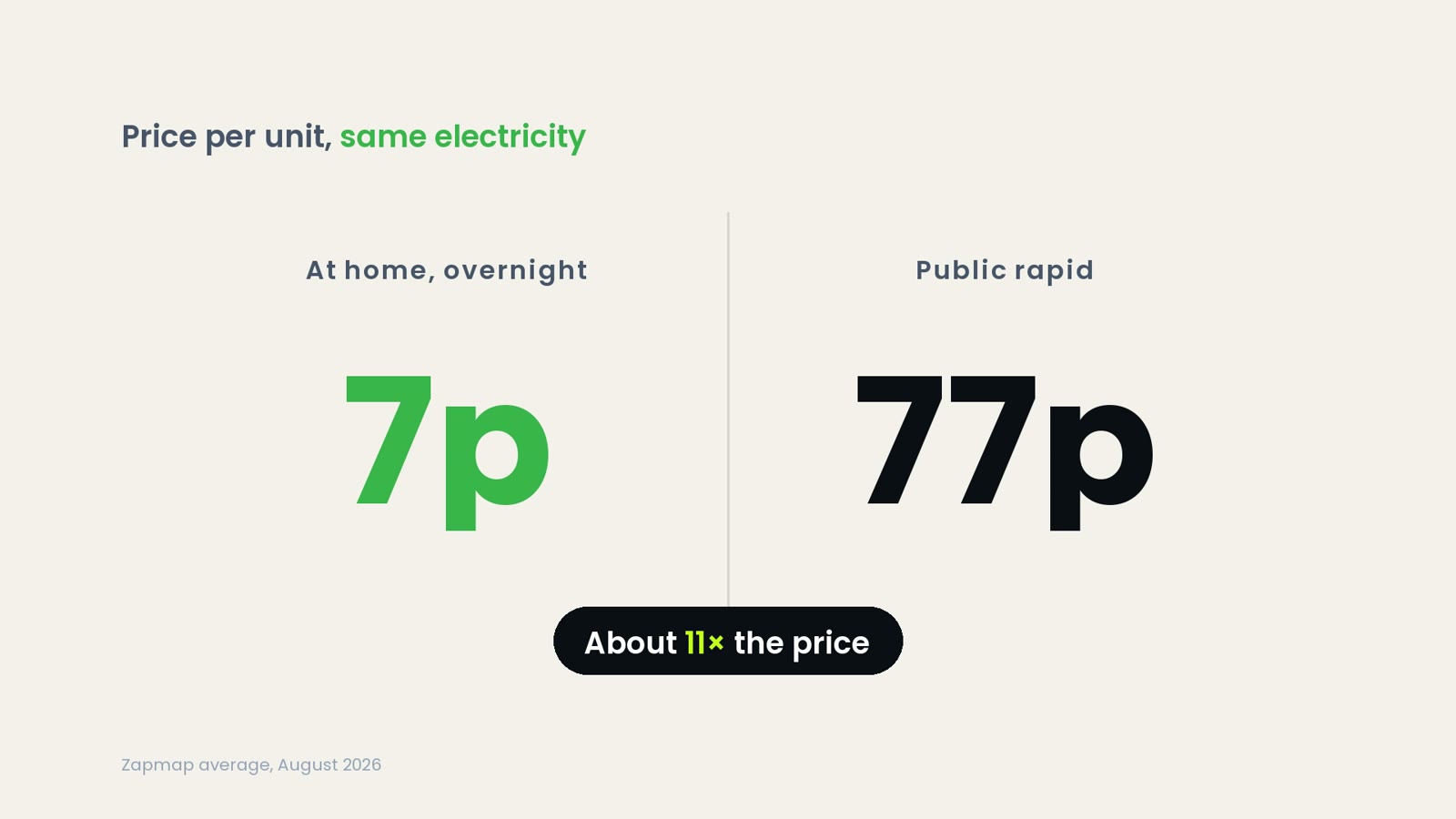
7p a unit vs 77p a unit
VAT is only part of the story. A good overnight EV tariff is around 7p a unit. The average public rapid charger is around 77p a unit. Same electricity, same car, and one costs about 11 times the other.
What it's worth over a year
Take a typical driver: 10,000 miles a year in a car that does about 4 miles per kWh. That's roughly 2,500 kWh of electricity a year. Here's what it costs depending on where it comes from:
- At home on an overnight EV tariff (about 7p): around £175 a year.
- At home on a standard tariff (about 24p): around £600 a year.
- On public rapid chargers (about 77p): around £1,925 a year.
That's roughly £1,750 a year between charging at home overnight and doing it all on rapids. Most people mix and match, so here's a more realistic picture: charge at home overnight 80% of the time, use rapids for the other 20%, and it comes to about £525 a year. That's still three times the cost of doing it all at home.
ChargeUK, the industry body, puts the VAT part of the gap alone at about £200 a year for a driver who can't charge at home.
How to actually get the 7p rate
The cheap rate doesn't happen by itself. You need three things:
- A smart meter, so your supplier can charge different prices at different times of day.
- An EV tariff with a cheap overnight window. Most big suppliers have one. Compare the length and timing of the cheap window as well as the price.
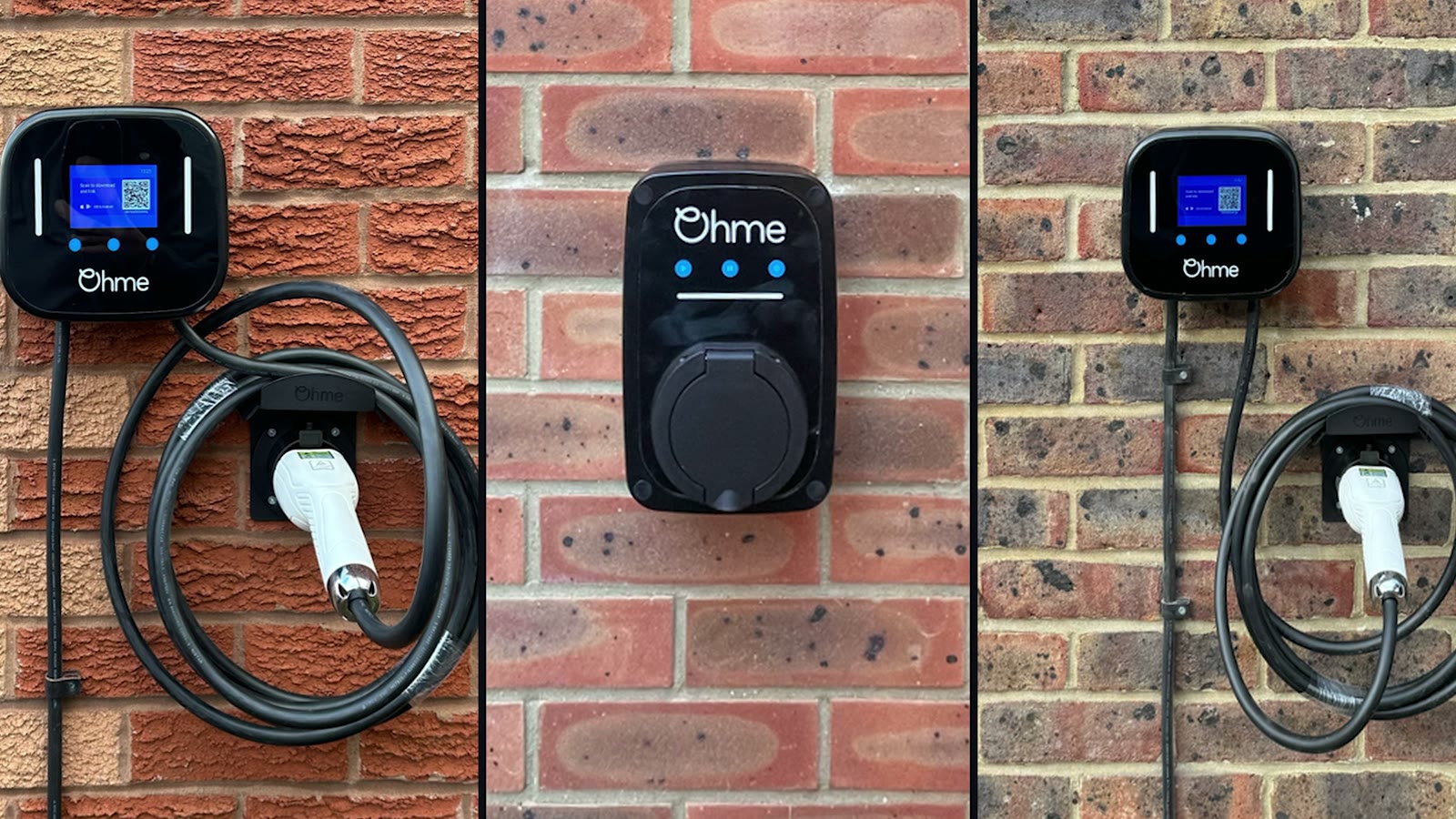
- A smart charger that does the charging in the cheap hours. Both chargers we fit, the Ohme Home Pro and the Ohme ePod, work with a wide range of UK EV tariffs and schedule the charge for you, so you just plug in when you get home.
On many EV tariffs the cheap rate covers the whole house, not just the car. Run the dishwasher and the washing machine in the same window and the saving goes further.
When you do need to charge in public
Even with a charger at home, you'll use public charging on long trips. A few ways to keep the cost down:
- Check the price per kWh in the app before you plug in. Prices vary a lot between networks, and even between sites on the same network.
- Slower chargers are usually cheaper than rapids. If you're parked for a few hours anyway, at the supermarket or in town, a slower charger often costs less per unit.
- Save rapids for long journeys. They're for getting back on the road quickly, not everyday top-ups.
- Look at network subscriptions if you use one network a lot. Some offer a lower rate per unit for a monthly fee.
Who should act now
- Got off-street parking but no charger? This is the push. The 0% rate runs to 31 March 2027, and every month without a charger is another month at public prices.
- Renting, or own a flat with your own parking space? You could get 75% off the cost of a charger, up to £500, through the chargepoint grant for renters and flat owners.
- No driveway? The rules on pavement charging channels have just changed in England, and there's a grant of up to £500 for those too. Here is how it works.
Questions we get asked
Do I need to tell my supplier?
No. The 0% rate is applied to your bill automatically.
Is the charger itself VAT-free now?
No. The 0% rate is on the electricity you use at home, not on buying or installing a charger.
Does it apply to public chargers at all?
No. Public charging still carries 20% VAT.
What happens after 31 March 2027?
The zero rate is temporary, and there's no promise it'll be extended. Even if it goes back to 5%, charging at home on an EV tariff will still cost a fraction of public rapid prices.
For more on the VAT change itself, read home charging just got even cheaper.
Want to know what a charger would cost on your home? Get a proper quote here, or see our guide to choosing a home charger.


