
On 28 October, Chancellor John Healey's Budget put £100 million towards cheaper public charging. It's aimed at the slower chargers on residential streets, the ones you plug into overnight when you've got nowhere else to charge.
If you charge on your own driveway, this won't change your bills much. If you rely on the charger round the corner, it could save you around £150 a year. Here's what's been announced, what it's actually worth, and what it tells you about where charging is heading.
What the Budget announced
- £100 million over two years, starting in spring 2027, to cut prices at lower-powered public chargers near people's homes.
- Who it's for: drivers who use on-street chargers where you leave the car for hours or overnight. These make up about a third of the UK's 124,000-plus public charge points.
- The target saving: around £150 a year on average for drivers who rely on them.
- A "tariff porting" taskforce, led by industry experts, to look at letting drivers use their home energy tariff at certain public chargers.
- No VAT cut for public charging: it stays at 20%. Home electricity has been VAT-free since 1 October and stays that way until 31 March 2027.
The Department for Transport hasn't said exactly how the money will reach drivers yet. More detail is promised "in due course", so treat £150 as a target rather than a promise. You can read the announcement on GOV.UK.
Why public charging needed help
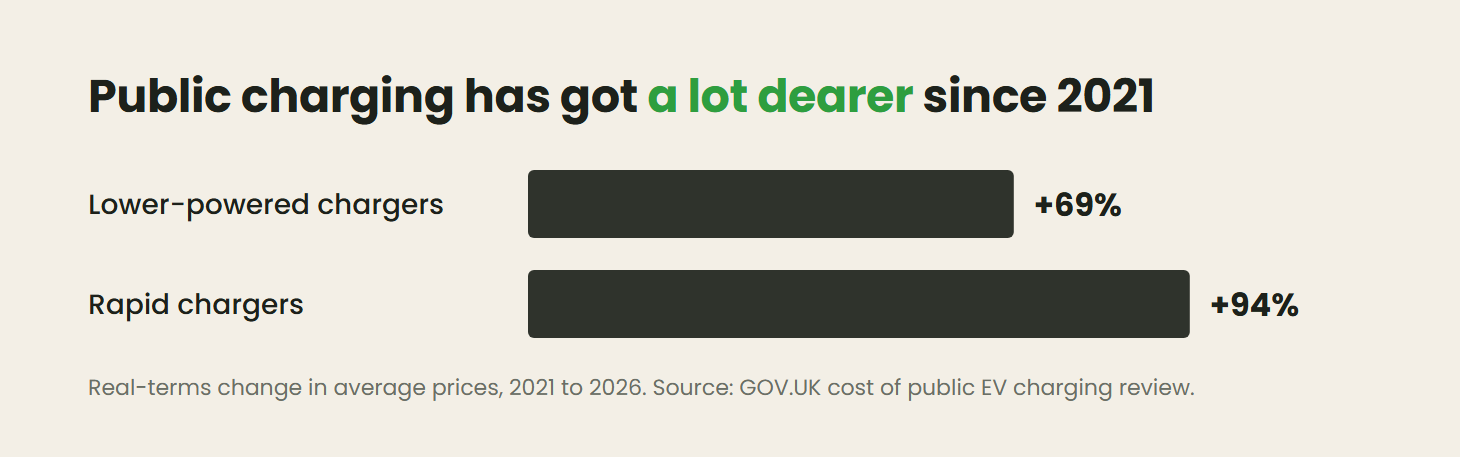
The government's independent review into public charging found that since 2021, prices at lower-powered chargers have risen by 69% and prices at rapid chargers by 94%, after inflation. That's a big jump for the third of UK households who don't have off-street parking.
Here's what that looks like per mile. We've used Zapmap's October 2026 averages (54p per kWh at standard public chargers, 82p at rapid ones), a typical EV doing 3.5 miles per kWh, and petrol at 167p a litre in a 45mpg car:
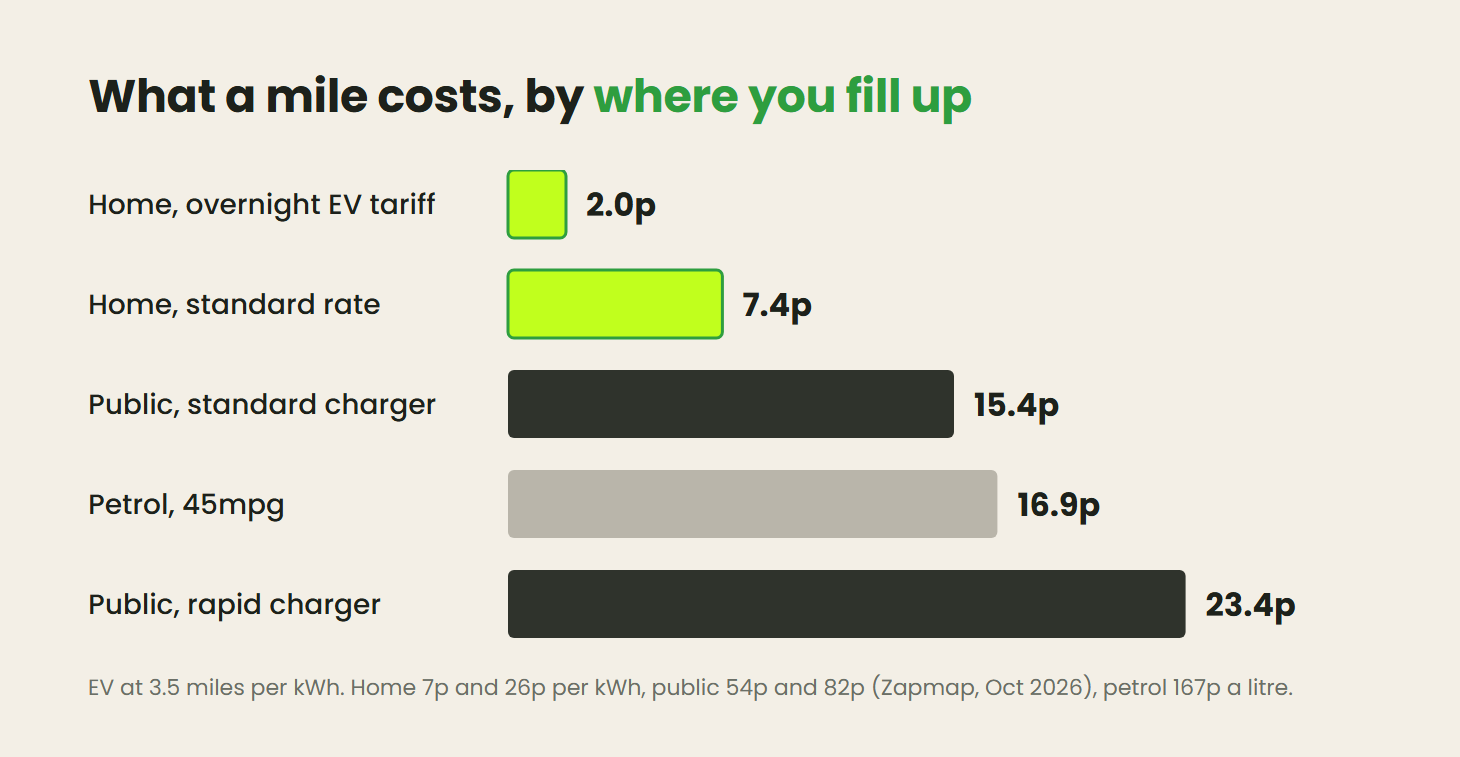
Charging at a slow public post now costs almost as much per mile as petrol. On a rapid charger it costs more. Charging at home on an overnight EV tariff costs a fraction of either. That gap is what the £100m is trying to close.
What £150 a year looks like
Take an average driver. The latest National Travel Survey puts that at about 7,100 miles a year, which is roughly 2,030 kWh of charging in a typical EV.
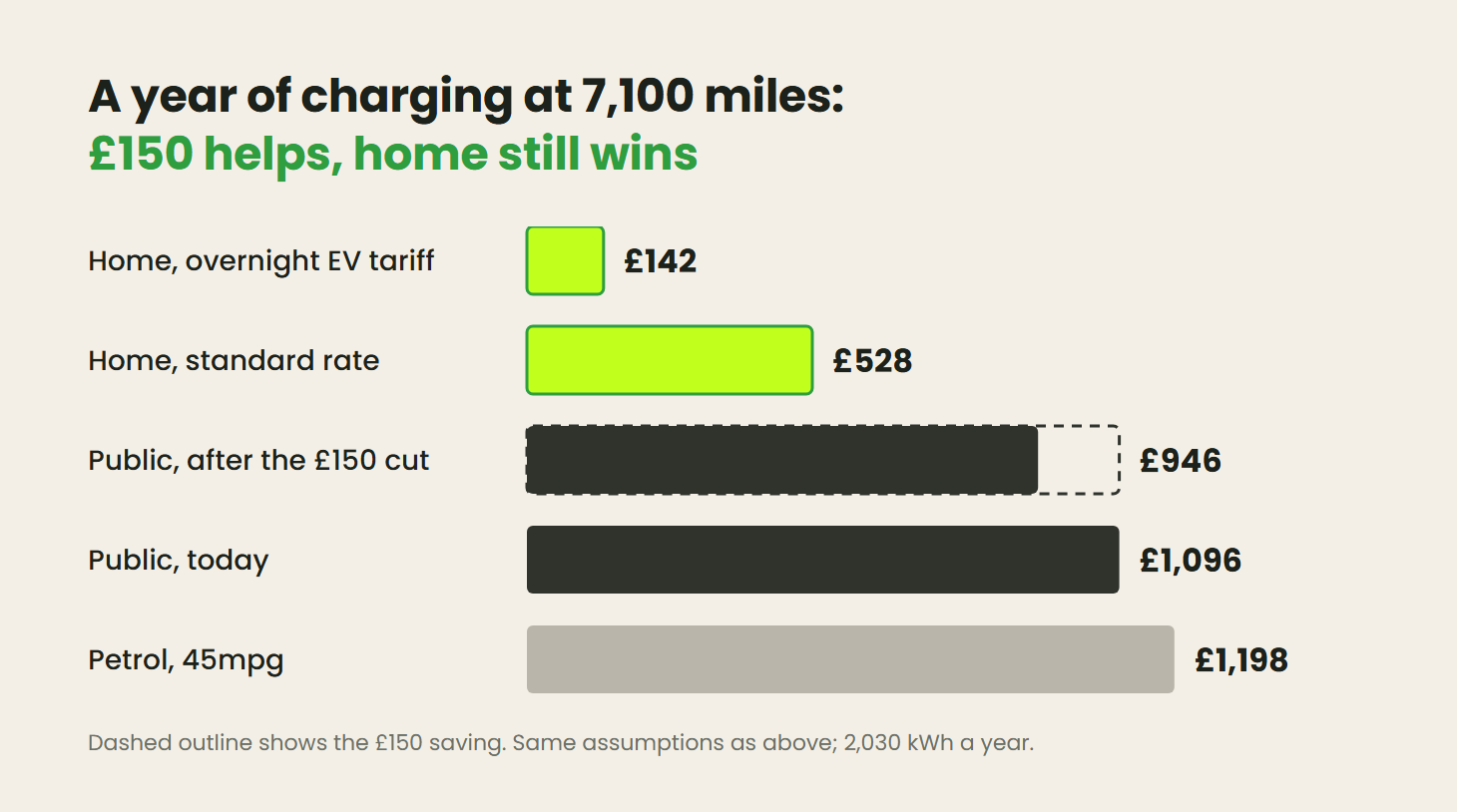
- Public charging today: about £1,096 a year.
- With £150 off: about £946. That's roughly 14% off, the same as knocking around 7p off every kWh.
- Charging at home overnight: about £142 a year.
So £150 is a welcome saving, but on-street charging will still cost several times more than a home charger on an EV tariff. If you can charge at home, that's still where the real money is.
Tariff porting: the bit to watch
The bigger idea in the Budget is the taskforce. Tariff porting would let you plug into a nearby public charger and pay your own home energy rate, cheap overnight rates included, instead of the charger operator's price. Your energy supplier would bill you as if you'd charged at home.
It's early. There's no start date, and it's expected to cover certain lower-powered chargers, not motorway rapids. But for the third of households without a driveway, it could make the biggest difference of anything in this Budget.
What it could look like
Say you're on a 7p overnight tariff and you plug into the charger outside your flat at 11pm for a 60 kWh top-up:
- Today, at 54p a kWh: about £32.40.
- With tariff porting, at 7p a kWh: about £4.20.
That's an illustration only. The rules haven't been written yet, and there may be fees on top.
VAT: 20% in public, 0% at home
Since 1 October, there's been no VAT on the electricity you use at home in England, Scotland and Wales. That runs until 31 March 2027. Plenty of drivers were hoping the Budget would do something similar for public charging. It didn't. Electricity at public chargers is still taxed at 20%, so that gap is baked into every public charge you buy. We've covered it in more detail in Charging At Home Just Got 20% Cheaper Than Public.
No driveway? You may still have options
The £100m is aimed at people who can't charge at home. But no driveway doesn't always mean no home charger.
- Flat with allocated parking: the £500 government chargepoint grant for renters and flat owners is still open. Our guide to getting a charger in a flat walks through who pays and who needs to say yes.
- Parking on the street outside your house: more councils now allow a cable channel across the pavement. Here's how pavement charging channels work.
- Not sure either way? Our video below covers the options.
What this means for you
If you already charge at home
Nothing changes. You're already on the cheapest charging there is. Keep using an overnight EV tariff and you'll stay well ahead of public prices, with or without the £100m.
If you rely on public chargers
Help is coming from spring 2027, but it's modest. Before you count on it, check whether a home charger or a cross-pavement solution is possible where you live. It's usually the bigger saving by a long way.
If you're thinking about going electric
Plan your charging before you choose your car. Work out where you'll charge most of the time, because that decides your running costs more than anything else. Our guide to choosing a home charger is a good place to start.
Questions we get asked
When will public charging get cheaper?
The £100m fund starts in spring 2027. The Department for Transport hasn't said yet how the money will reach drivers, so watch for more detail early next year.
Will every public charger get cheaper?
No. It's aimed at lower-powered chargers on residential streets, the ones people use overnight near home. Motorway rapids aren't the target.
Is charging at home VAT-free for good?
No. The 0% rate on home electricity runs until 31 March 2027 in England, Scotland and Wales. Northern Ireland stays at 5%.
Not sure if you can get a charger at your place? Tell us about your parking and we'll give you a straight answer. Get in touch, or read about our home EV charger installation.


