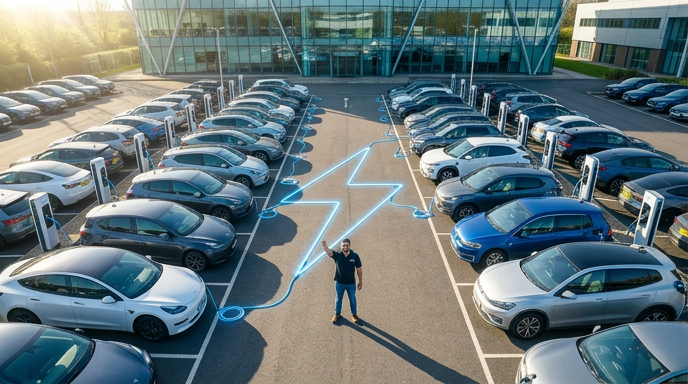

If you have been putting off installing EV chargers at your business premises, 2026 is the year the maths changed.
The UK's Zero Emission Vehicle (ZEV) mandate requires 33% of all new cars sold in 2026 to be fully electric, up from 28% in 2025. Manufacturers are pushing hard to hit that number, offering significant discounts and incentives to shift EVs. The result: faster workforce EV adoption, more employees arriving at work in an electric vehicle, and a rising expectation that their employer will help them charge.
The Numbers Behind the Shift
- 33% of new cars must be electric in 2026 under the ZEV mandate, a sharp step up from the 28% target in 2025.
- The UK now has over 70,000 public charge points, but workplace charging remains one of the most underserved segments.
- Manufacturers facing ZEV mandate penalties of £15,000 per non-compliant vehicle are heavily discounting EVs to hit targets, accelerating workforce EV uptake.
- Employees with a workplace charger drive significantly more miles on electricity than those relying solely on public charging.
The direction of travel is clear. The question is whether your business gets ahead of it now, or catches up later at greater cost.
The Business Case, Broken Down
1. Attract and Retain Talent
Workplace EV charging has moved from novelty to expectation in sectors where EVs are common: professional services, tech, and logistics in particular. In a competitive hiring market, the absence of charging infrastructure is increasingly noted in employer reviews and candidate conversations.
2. HMRC Tax Efficiency
Providing free workplace electricity for employees to charge their personal EVs is currently not treated as a benefit in kind. That means you can offer something genuinely valuable to staff at no personal tax cost to them, making it one of the more efficient workplace perks available right now.
3. Fleet Electrification
If you operate a company fleet, workplace charging is the backbone of your electrification strategy. Overnight or daytime charging at your base dramatically reduces reliance on public charging networks and cuts your per-mile fuel costs considerably.
4. Government Funding: Workplace Charging Scheme
The OZEV Workplace Charging Scheme (WCS) provides up to £350 per socket towards installation costs, capped at 40 sockets per applicant. For a 10-socket installation, that is £3,500 straight off your capital cost. Combined with time-of-use commercial energy pricing, the payback period on a commercial EV charging installation has shortened considerably in recent years.
5. Future-Proofing Your Premises
Commercial property valuations and lease negotiations increasingly factor in sustainability credentials, including EV charging provision. Installing now improves your ESG profile and reduces the risk of a costly retrofit as legislation tightens and tenant expectations rise.
What Types of Charger Work for Businesses?
The right setup depends on how your premises is used:
- Destination charging (retail, hospitality, car parks): AC fast chargers (7kW to 22kW) allow customers to top up during a visit.
- Employee and fleet charging: 7kW AC chargers with smart load management are the workhorse solution. Multiple units share your available electrical supply efficiently.
- Fleet depot or logistics hub: 50kW-plus DC rapid chargers may be appropriate where vehicles need significant charge within short windows.
At Plug In Stations, we survey your site, assess your electrical capacity, and design a system that fits your operations. Visit our commercial charging page to see the full range of solutions we install.
What Does the Installation Process Look Like?
A typical commercial installation follows these steps:
- Site survey: covering electrical supply capacity, parking layout, and cable routing options
- Design and quote: including Workplace Charging Scheme grant eligibility assessment
- DNO application: if your electrical supply needs upgrading to accommodate the new load
- Installation: typically one to two days depending on the scope
- Commissioning and handover: including a staff walkthrough of the charger management platform
Plug In Stations handles all of this end to end, from your first call to the day your team starts plugging in.
Act Now: Installation Capacity Is Tightening
The surge in EV registrations flowing from the ZEV mandate means that demand for commercial charging installation is set to rise sharply in the second half of 2026 and into 2027. Getting your survey booked now means your site is ready before the rush.
Sources:What Car? - ZEV mandate 2026 | EVA England - ZEV mandate | CBS - ZEV mandate for retailers 2026
Explore commercial EV charging for your business
Plug In Stations designs and installs workplace and commercial charging systems across the UK. OZEV-registered. Fully managed from survey to sign-off.


