
The 99% Promise That Isn't Being Kept
Since January 2026, UK law has required rapid chargers (50kW and above) to maintain 99% uptime. It sounds reassuring. The reality is quite different.
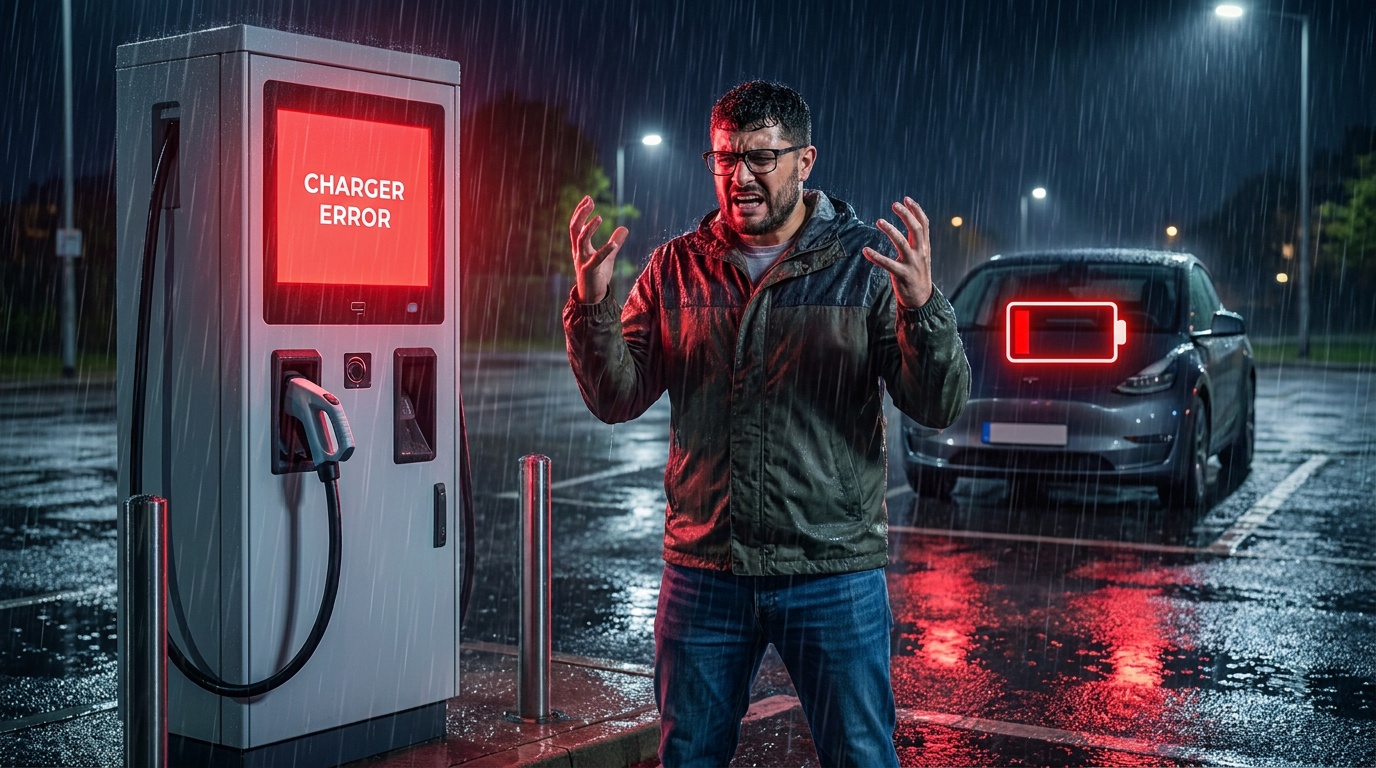
New compliance data published this summer found that only 3.9% of charge point operators currently meet the threshold. More strikingly, the first-time success rate at public rapid chargers sits at around 71%. That means roughly one in three charge attempts results in a failed session, an error screen, or a connector that simply will not communicate.
For drivers who rely on the public network, that is a real problem. For anyone on the fence about switching to electric, it is exactly the kind of statistic that gives pause. Here is what the data means in practice and, more importantly, what you can do about it.
Why Do Chargers Break?
Public charge point failures tend to fall into a handful of common categories:
- Software and payment issues: authentication systems crashing or firmware updates going wrong.
- Physical damage: cracked screens, frayed cables, connectors jammed by vandalism or hard use.
- Network outages: the hardware is fine but cannot reach the backend to authorise your session.
- Slow maintenance response: some operators take days to repair a reported fault; a few take considerably longer.
The government mandate also requires operators to fix 99% of reported faults within 24 hours. Many are not yet meeting that standard either.
Which Networks Are Most Reliable?
Not all networks are equal. Independent monitoring by Zap-Map, which aggregates real-time fault reports from UK EV drivers, consistently shows wide variation in reliability. As a general guide:
- Larger, better-funded networks tend to have faster fault-resolution times and more modern hardware.
- Older rapid chargers installed before 2022 are significantly less reliable than newer units.
- Rural locations suffer more from the connectivity issues that affect payment and authentication systems.
A 2026 audit by Zest found that roughly half of 38 rapid operators appeared to meet the 99% standard, while 22 did not. The situation is improving, but unevenly.
How to Protect Yourself
A bit of preparation makes a big difference. Before any journey where you plan to use a public charger:
- Check Zap-Map before you arrive. User comments are usually current and will flag a charger that has been down for days.
- Have a backup location. Know the next nearest charger on your route so you are never stranded if the first one is out of order.
- Report faults. Use the in-app reporting tool or call the operator's helpline. It helps other drivers and speeds up the repair queue.
- Screenshot any error. If you are charged for a session that did not complete, you will need evidence to claim a refund.
The Best Backup Is at Home
The honest truth: the public network is improving, but it is not yet as reliable as it needs to be. For most UK EV owners, home charging is not just convenient. It is the foundation of a stress-free ownership experience.
When you charge overnight at home, you start every day with a full battery, at a fraction of the public network cost, using a charger you know works. The home chargers we install at Plug In Stations are rated, tested and backed by our aftercare team. If something ever does go wrong, you have someone to call.
If you are still relying primarily on public charging, it may be time to consider a home charger installation. You may also be eligible for an OZEV grant that covers a portion of the cost.
Get Charged at Home


