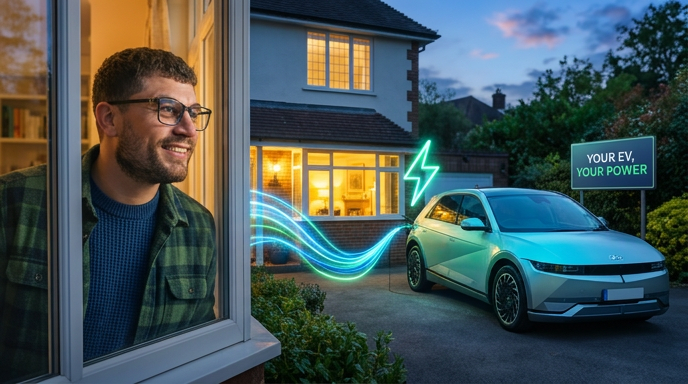

Your EV battery is one of the biggest stores of energy you own. It sits unused on the drive most of the day. Vehicle-to-grid technology, or V2G, lets that energy flow the other way: out of the car and into your home or back to the grid, instead of only ever flowing in.
It is one of the most exciting ideas in home energy, and in 2026 it is finally real in the UK, with some important caveats. Here is the honest picture.
V2G and V2H, explained simply
There are two ideas worth knowing:
- Vehicle-to-home (V2H): your car powers your house, working like a large home battery during expensive peak hours
- Vehicle-to-grid (V2G): your car also exports spare energy back to the grid when demand is high, and you get paid for it
In both cases the car charges up cheaply overnight, then puts that energy to work when electricity is most expensive.
What it looks like in practice
The standout example in the UK is Octopus Power Pack, billed as the country's first V2G tariff. It charges your car when energy is greenest and cheapest, uses it to cover your home first, then exports the surplus to support the grid. For qualifying drivers it can make home charging effectively free.
One bundle pairs a V2G-ready BYD Dolphin with a bidirectional charger and the smart tariff for a single monthly price covering the car, the charger, installation and the software. Older setups using a Nissan Leaf or Mitsubishi Outlander with a first-generation bidirectional charger can also work.
The honest catch, for now
V2G is genuinely early. Before you get carried away, know that:
- Most EVs cannot do it yet. Only a small number of cars and chargers currently support discharging
- You need export approval. Sending power to the grid needs a G99 application, which can take up to 12 weeks and is not guaranteed
- The hardware is limited. Bidirectional chargers cost more and there are only a few approved models
Should you wait or act?
If you are buying a brand new EV and charger today, it is well worth asking whether they are V2G-ready, even if you do not switch it on straight away. That small bit of future-proofing means you are ready the moment your energy supplier opens the door, rather than replacing kit in two years.
Getting your home ready
Whether you want V2G now or simply want to be ready for it, the foundations are the same: a properly specified consumer unit, a compatible smart charger, and an installer who understands export and bidirectional setups. That is exactly the sort of forward-looking install we love to get right first time.
Want to future-proof your setup?


