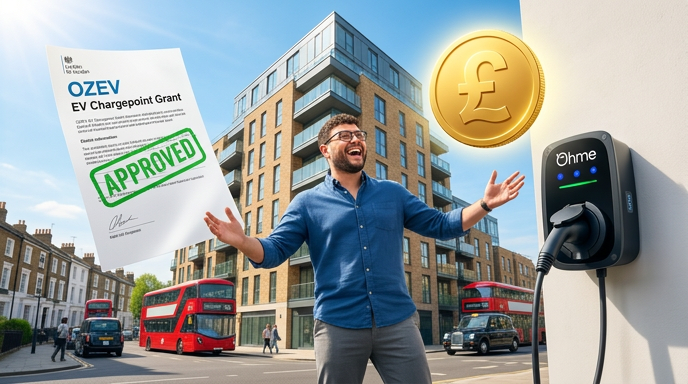

Many people assume the government's EV charger grant is only for homeowners with a driveway. That assumption has been out of date for years. In 2026, the OZEV grant (officially the EV Chargepoint Grant) is targeted specifically at renters, flat owners, and landlords. Standard owner-occupiers of detached or semi-detached houses were removed from the household scheme back in 2022.
If you rent your home, own a flat, or are a landlord, you may well be eligible. And the process changed significantly from April 2026.
Who Is the OZEV Grant For in 2026?
The current scheme covers:
- Private renters in houses or flats
- Flat owners (leasehold or freehold)
- Residential landlords fitting chargers at rental properties
- Households with only on-street parking who are installing an approved cross-pavement solution
For businesses and organisations, a separate Workplace Charging Scheme (WCS) provides up to £350 per socket for employee and fleet charging installations.
How Much Is the Grant Worth?
For renters and flat owners applying through the residential route, the grant covers up to £350 per socket. The scheme has been extended until 31 March 2027, giving you good runway to apply.
What Changed in April 2026?
The most significant practical change is the application platform. From 1 April 2026:
- The old OZEV portal has been replaced by the Find a Grant platform (managed by the government's business grant service).
- Renters and flat owners now apply directly on Find a Grant, rather than relying on their installer to initiate the application.
- You will need to register for a Find a Grant account before starting.
- Landlord applications follow the same direct process.
This is a genuine improvement. Previously, the process could feel opaque because you depended on your installer to kick it off. Now you can log in, start your own application, and track its progress directly.
What Do You Need to Apply?
Before you open Find a Grant, make sure you have:
- Proof of your tenancy or lease (tenants), or Land Registry documentation (flat owners)
- Details of the EV charger you intend to install (your installer can provide this)
- Your installer's OZEV registration number (all PIS installations use our registered details)
- Evidence that your vehicle is, or will be, kept at the address
Applications typically take up to 10 working days to assess once submitted, provided no additional evidence is needed.
Flat Owners: Special Considerations
Installing a charger in a flat building adds some complexity, such as permission from the freeholder or managing agent, a suitable location for the charge point, and cabling that works with shared or allocated parking.
At PIS, we handle flat and apartment installations regularly. Our pre-installation surveys cover all of these points, and we can advise on the best approach for your specific building before you commit. Find out more about our home charging service.
Does the Grant Cover the Full Cost?
No. The grant covers up to £350 of the installation cost. A typical home charger installation costs between £700 and £1,200 depending on the property, charger model, and cable run length. The grant meaningfully reduces your outlay but does not eliminate it.
It is worth remembering that a smart home charger pays for itself relatively quickly. Overnight EV tariffs (around 8p to 9.5p/kWh) versus standard daytime electricity (24.67p/kWh at the April 2026 Ofgem price cap) translate to savings of £400 to £500 per year for a typical driver.
Getting Started
The quickest route is to speak to your installer first. We will confirm your property is suitable, recommend the right charger, and make sure our OZEV registration details are ready for your Find a Grant application. Visit our OZEV grant page for a full overview of what we cover.
Get an OZEV-approved charger installed by PIS
Plug In Stations is an OZEV-registered installer. We handle surveys, permissions, and support your Find a Grant application every step of the way.


