
From 1 April 2028, electric car drivers will pay for every mile they drive: 3p a mile for fully electric cars and 1.5p a mile for plug-in hybrids. It's called Electric Vehicle Excise Duty, or eVED, and the Budget on 28 October confirmed it's going ahead.
Here's what you'll actually pay at your mileage, how paying it will work, and why it doesn't change the case for charging at home.
The quick version
- Starts: 1 April 2028.
- Rates: 3p a mile for battery electric (and hydrogen) cars, 1.5p a mile for plug-in hybrids.
- On top of normal road tax: EVs have paid standard Vehicle Excise Duty since April 2025. For 2026/27 that's £200 a year after the first year.
- Rises with inflation: the per-mile rate goes up with CPI from 2029 to 2030.
- Who runs it: the DVLA, alongside your normal road tax.
The full policy paper is on GOV.UK.
What you'll pay at your mileage
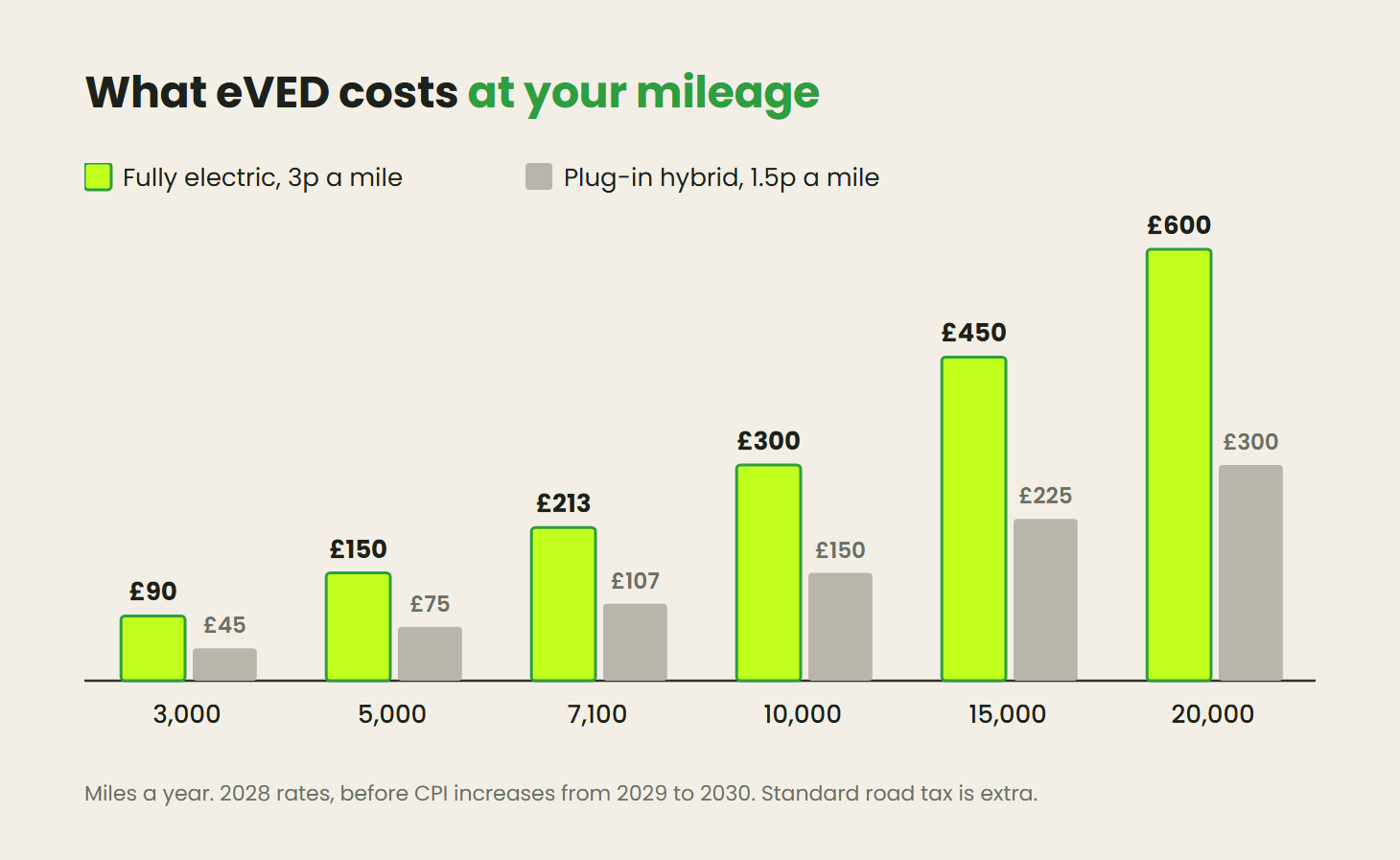
The town driver: 4,000 miles
£120 a year, or £10 a month. School runs, the shops and the odd weekend away.
The average driver: 7,100 miles
About £213 a year, or just under £18 a month. That's the typical mileage in the latest National Travel Survey.
The big commuter: 15,000 miles
£450 a year, or £37.50 a month. If you drive this much, home charging matters even more, because every mile you charge cheaply adds up fast.
Remember, that's on top of standard road tax unless your car's in its first year.
How paying it will work
The government has set out the process:
- When you renew your road tax, you give your car's odometer (mileage) reading.
- You estimate how many miles you'll drive in the year ahead.
- You pay up front based on that estimate, or spread it across the year.
- At the end of the year, your next mileage reading settles up the difference.
- Mileage recorded at MOTs is used to check readings, so if your car already has an MOT there should usually be no extra steps.
Tip: you can look up your car's past MOT mileages on GOV.UK today. It's the quickest way to see what you really drive in a year, and what eVED will cost you.
How it compares with petrol
Petrol drivers don't pay per mile. They pay fuel duty at the pump, currently 52.95p a litre, with VAT added on top. In a 45mpg car that's about 5.3p a mile in duty before VAT. An EV's 3p a mile is a bit over half that.
Put everything together, at today's prices and an average 7,100 miles a year:
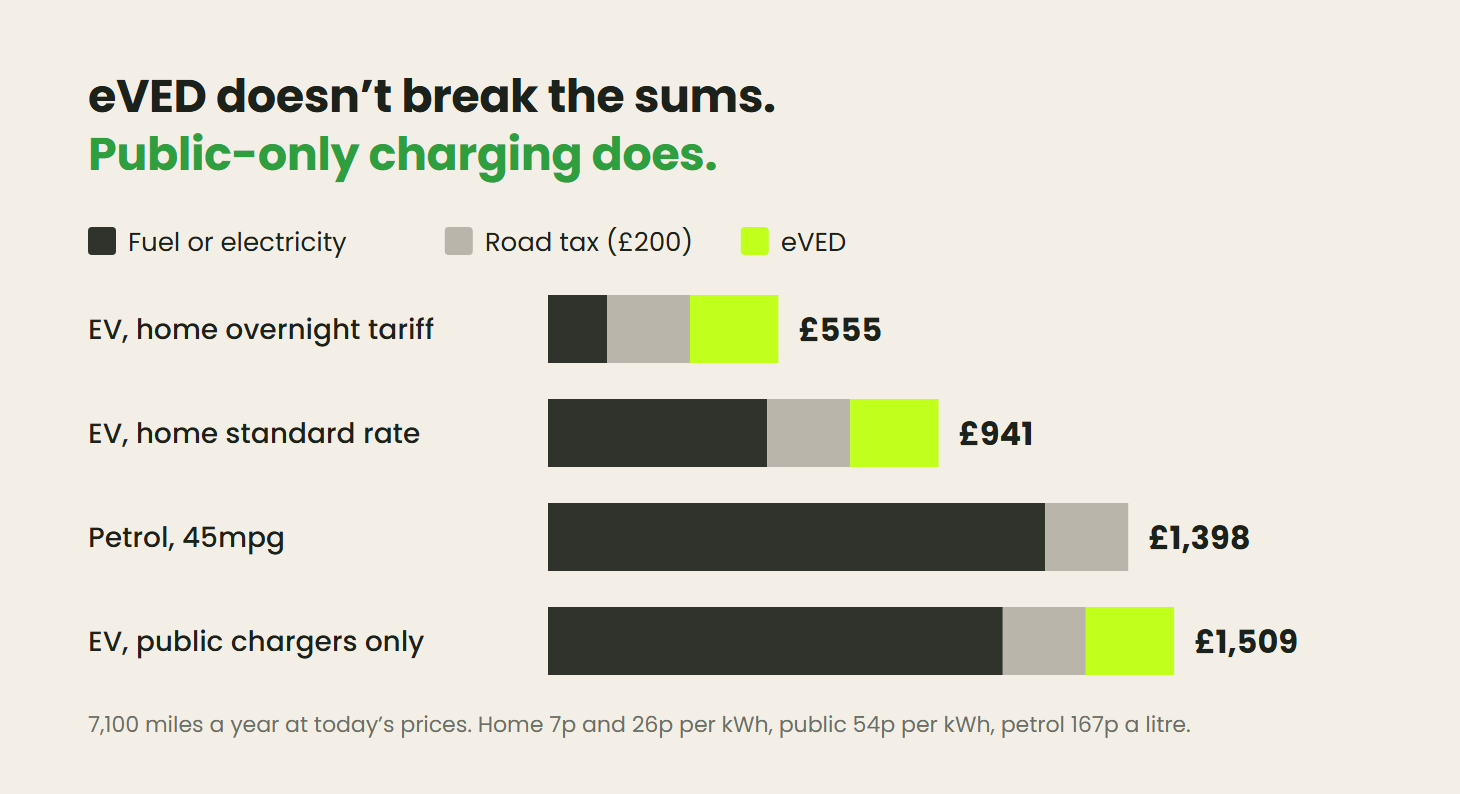
- EV charged at home overnight: about £142 electricity, £200 road tax and £213 eVED. Roughly £555 a year.
- Petrol car: about £1,198 fuel and £200 road tax. Roughly £1,398 a year.
- EV charged only at public standard chargers: about £1,096 electricity plus the same tax. Roughly £1,509 a year.
So eVED doesn't break the case for going electric. Charging at home overnight still leaves you about £843 a year better off than petrol. What does change the sums is relying entirely on public charging. That's why the new £100m fund for cheaper street charging matters for drivers without a driveway.
Just for fun: driving to the Moon
The Moon is about 238,900 miles away. Drive an EV there and the eVED alone would come to £7,167. Charged at home overnight, the electricity would cost about £4,778. The same trip in a 45mpg petrol car would need around 24,000 litres of fuel, or about £40,300 at today's prices. We worked out the rest of the trip here:
What to do now
- Check your mileage using your MOT history, so you know what eVED will cost you.
- Get your charging sorted. Home charging is still the single biggest saving an EV driver can make.
- Catch up on the last Budget: our Autumn Budget 2025 guide covers when eVED was first announced.
Questions we get asked
Does eVED replace normal road tax?
No. It's on top of standard Vehicle Excise Duty, which is £200 a year for 2026/27 after the first year.
Do plug-in hybrids pay it?
Yes, at half the rate: 1.5p a mile.
Will I need a tracker fitted to my car?
No. It's based on odometer readings when you renew your road tax, checked against the mileage recorded at MOTs.
Want the cheapest miles going? Find out about our home EV charger installation, or get in touch and we'll talk you through it.


