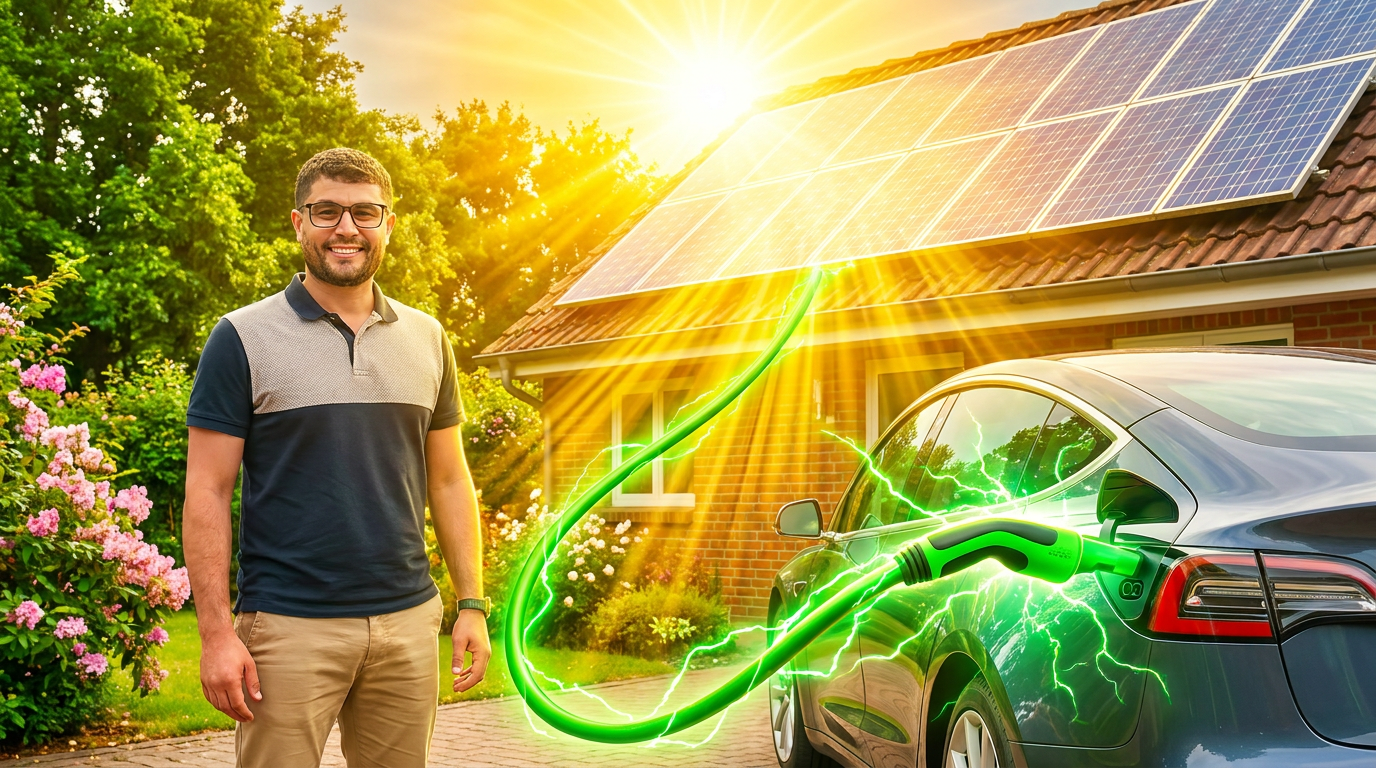

If you have solar panels on your roof, or you are thinking about getting them, there is a natural next question: can I use that free electricity to charge my car? The answer is yes, with the right home charger and a bit of setup. And when it works well, it genuinely gets close to free charging on sunny days.
How Solar EV Charging Works
Solar panels generate electricity whenever the sun is out. Any surplus that your household does not use in the moment gets exported to the grid, typically at an export tariff of around 15p per kWh in 2026.
A solar-aware EV charger monitors how much surplus your panels are producing in real time, using a device called a CT clamp (current transformer) that clips around your main household cable. When surplus is detected, the charger diverts it into your car's battery rather than sending it to the grid. Instead of getting 15p per kWh for your exported energy, you are using it yourself, at the equivalent value of the incoming grid rate (now around 26p per kWh after the July price cap rise).
That 11p per kWh difference, multiplied across hundreds of charging sessions, adds up quickly.
What You Need to Make It Work
Three things:
- A solar PV system, typically 3.5kW to 6kW for a family home
- A solar-aware smart EV charger with CT clamp input
- An accredited installer to commission both systems together correctly
The CT clamp is the critical piece that most standard smart chargers do not have. Without it, your EV charger has no way of knowing how much solar is being generated and cannot divert intelligently.
Which Home Chargers Do Solar Diversion Well?
Not all home EV chargers support solar diversion. The three most popular solar-compatible units in the UK are:
Zappi (by myenergi)
The original solar-divert charger and still the most widely installed. It works alongside myenergi's Eddi (hot water diverter) and Libbi (home battery) if you want to build out a fuller home energy system later. A solid, proven choice.
Hypervolt Home 3 Pro
Has CT clamp compatibility built in and a polished app with good scheduling tools. Functions as a standard smart charger in the usual way and switches to solar divert mode automatically when surplus is detected.
Andersen A3
A premium option with solar divert capability, smart scheduling, and a very tidy aesthetic if the visual finish of the installation matters to you. Popular in properties where the charger is prominently visible.
All three meet the legal requirement for all new home charge point installations in Great Britain to be smart chargers. For a wider comparison, Spirit Energy's solar EV charger guide has a detailed breakdown.
Do You Need a Home Battery Too?
A home battery (such as a GivEnergy unit or a Tesla Powerwall) is not essential for solar EV charging, but it extends what you can do. Without a battery, you can only charge your car when the sun is actually generating surplus. With a home battery, you store daytime generation and use it to charge the car in the evening or overnight.
Home batteries typically cost £5,000 to £10,000 installed. For households with longer commutes or irregular charging patterns, the extra flexibility can justify the cost over the medium term.
What Are the Real Savings in 2026?
A 4kW solar system in the UK generates around 3,400 kWh per year on average. If you use a third of that for EV charging rather than exporting it, you are avoiding buying roughly 1,100 kWh from the grid at 26p per kWh. That is around £286 per year saved just on the car, on top of the savings on your household electricity.
With the July 2026 price cap rise pushing the standard rate higher while export tariffs stay around 15p, the economics of consuming your own solar generation rather than exporting it have shifted further in your favour. Every kWh you put into your car is now worth 11p more than exporting it would get you.
See the home charging service from Plug In Stations and the solar-compatible chargers we install.
Start Charging From Sunshine


