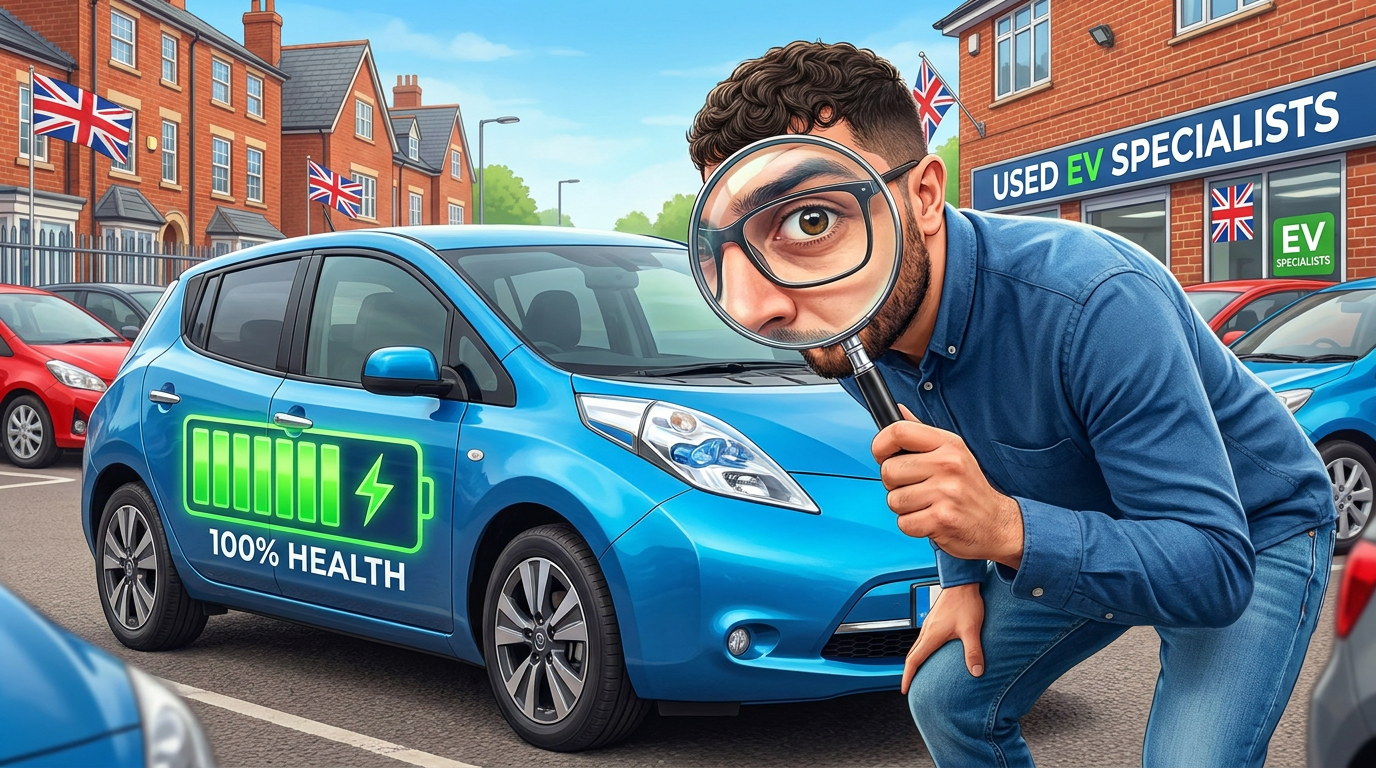

The first quarter of 2026 broke the UK record for second-hand EV sales, with nearly 87,000 used electric vehicles changing hands between January and March alone. That is up 32% on the same period a year earlier. Prices have come down significantly, the choice of makes and models has never been broader, and many people are picking up their first EV as a used car rather than going new.
That is largely great news. But second-hand EVs come with one health check that has no equivalent in the petrol car world: the battery.
What Is Battery State of Health?
State of health, usually abbreviated to SoH, tells you what percentage of the battery's original capacity remains. A brand-new EV starts at 100% SoH. After five years of typical use, it might be at 93%. After eight years, around 85%. Unlike a petrol engine, which typically degrades gradually over a long time, an EV battery that has had a rough charging life can degrade faster.
A recent large-scale UK study found reassuring averages: 4 to 5-year-old EVs retained a median SoH of around 93.5%, and 8 to 9-year-old vehicles held around 85% on average. For most buyers, those numbers are very liveable. But that is the median. Outliers exist, and you do not want to be the person who bought one without checking.
SoH Ratings and What They Mean for Range
- Above 90%: excellent; effectively equivalent to a near-new car for most drivers
- 80% to 90%: good; some range reduction but acceptable for the majority of use cases
- 70% to 80%: usable but negotiate hard on price; factor in a likely battery service in the medium term
- Below 70%: approach with caution; real-world range may be significantly reduced
To put it practically: a car originally rated at 250 miles of range with 85% SoH will deliver around 212 miles in similar conditions. Still very usable for most daily drivers.
How to Check Battery Health Before You Buy
The SoH figure does not appear on the dashboard of most cars. You have three routes to find it:
Ask the dealer for a battery health report
Reputable used EV dealers increasingly provide a battery health report as standard. If yours does not, ask for one. If they cannot or will not provide it, treat that as a yellow flag.
Get an independent OBD diagnostic check
A specialist EV technician can plug into the car's OBD port and generate a State of Health reading in minutes. This typically costs between £50 and £100. On any used EV purchase above £8,000, it is money very well spent.
Check manufacturer apps and displays
Some brands surface SoH data directly. The Nissan LEAF has a built-in battery capacity bar display on the instrument cluster. Renault, Kia, and several others offer SoH readings through their connected car apps. Check before the test drive.
Battery Warranties: What Transfers and What Does Not
Most EVs sold new in the UK come with a battery warranty of eight years or around 100,000 miles, whichever comes first. If the car you are considering is still within that window, the warranty may transfer to you as the second owner and could cover replacement if SoH drops below a threshold (typically 70% or 75%).
Read the small print carefully, and verify with the manufacturer or main dealer that the warranty is genuinely transferable and has not already been voided.
The RAC's used electric car guide has a useful overview of what to expect from different models and ages.
What to Do Once You Own It
Once you have your used EV, the single best thing you can do for long-term battery health is charge at home overnight with a dedicated home charger. Regular, slow, overnight charging at around 80% of capacity for daily use is far gentler on the battery than repeated rapid public charging at 150kW or more. Save the full 100% charge for longer trips.
Setting up home charging is straightforward with an OZEV-approved installer, and the £500 government grant helps with the cost.
Getting Ready for Your Used EV
- Get home charging installed for your new-to-you EV
- Find the right home charger for your car and home
- See how easy it is to get started with Plug In Station


